
Palais Lascaris in Nice: Baroque Palace and 500 Historic Instruments
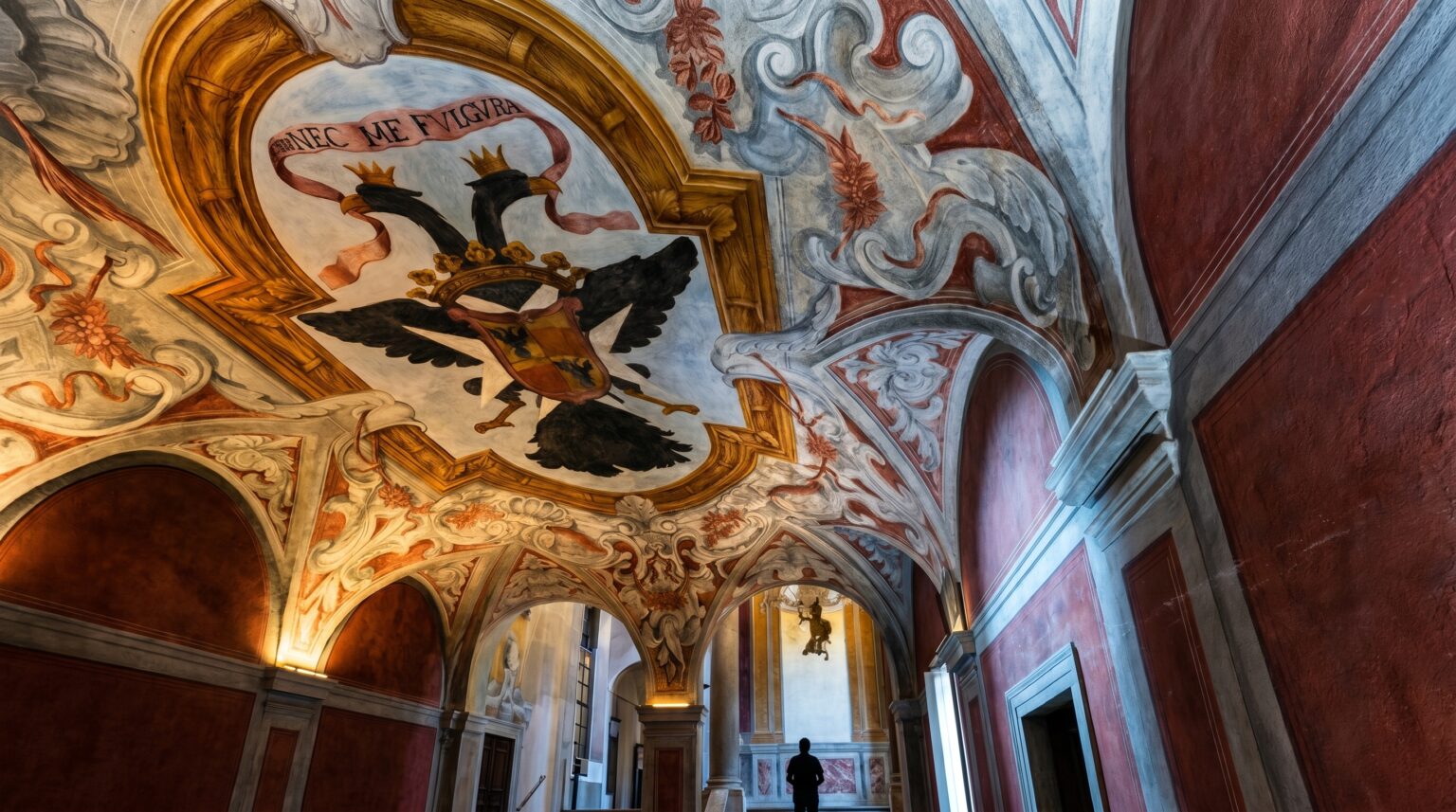
The Palais Lascaris, on rue Droite at the heart of Vieux-Nice, has two distinct lives. The first is that of a Genoese Baroque palace built in the mid-17th century for the Lascaris-Vintimille family, with monumental staircase, frescoes, reception rooms, and a façade typical of Niçois aristocracy under Ligurian influence. The second, less expected, makes it one of France’s most singular musical destinations.
From Private Palace to Municipal Museum
The building was purchased by the city of Nice in 1942. Restoration took place between 1962 and 1970, before opening to the public in its current configuration. The architecture remained faithful to the Genoese model: arcaded vestibule, grand staircase, painted ceilings, reception rooms decorated with Aubusson and Flemish tapestries, period paintings and furniture.
France’s Second Collection of Historic Instruments
What distinguishes Palais Lascaris from other museums in Vieux-Nice is a bequest. By testament dated 26 May 1901, the Niçois notable Antoine Gautier left to the city a considerable collection of historic musical instruments. Subsequent acquisitions brought the collection to more than 500 pieces, making it France’s second collection of musical instruments, after only the Musée de la Musique at the Philharmonie de Paris.
The collection spans primarily the 17th and 18th centuries: viols, recorder flutes, harps, guitars, harpsichords, wind instruments.
Three Pieces That Justify the Visit Alone
The tenor sackbut by Anton Schnitzer, dated 1581, is the collection’s flagship piece. It is the oldest sackbut in the world preserved in its original state, a simple fact yet difficult to overstate for those interested in the history of brass instruments.
The alto recorder by Johann Christoph Denner (early 18th century) is equally significant: Denner is credited with the invention of the clarinet, and each of his surviving instruments is a historical document in itself.
Finally, several prototypes of Sébastien Erard harps, whose mechanical innovations defined the modern harp at the turn of the 19th century, are preserved in the palace alongside exceptionally rare Baroque guitars.

Nice
Travel Book AEC CollectionHow to Visit
Entry is via rue Droite, in the heart of Vieux-Nice, with no parking nearby; access is on foot from place Garibaldi or cours Saleya. A visit takes 1 to 1.5 hours for those who linger over the musical collection; half that time for those who simply walk through the reception rooms. Temporary exhibitions periodically refresh the selection on display.
Planning a Stay in Nice
AEC Collection selects and represents distinguished apartments and villas in Nice and on the Riviera, from Vieux-Nice to Mont Boron and Cap-Ferrat. Opening hours of Palais Lascaris and museum programming should be confirmed with the Musées de la Ville de Nice.

Our properties in Nice
Exceptional chalets, villas and apartments, selected by our agents for their standing.
View the properties in Nice →