
Gornergrat at 3089m: practical guide to the Zermatt train
The red train departs Zermatt station at 8:00 and navigates the first steep curve bend three minutes later. No engine draws in the valley: the Gornergrat Bahn has run on electricity since it opened for service on 20 August 1898. Thirty-three minutes later, it deposits its passengers at 3089 metres, on a bare ridge exposed due south, facing one of the most photographed panoramas in the Alps: twenty-nine peaks above 4000 metres and the Matterhorn positioned precisely at the centre of the frame.
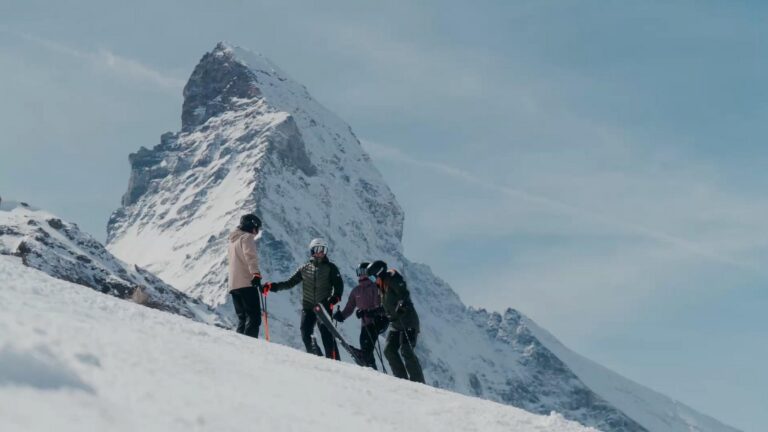
Gornergrat is not a ski resort. It is a railway viewpoint, accessible year-round, whose distinctive character rests on three things: Europe’s highest open-air railway, a 360-degree view of the Mont-Rose massif, and an observatory hotel planted at the summit since 1907. One ascends for the views, not for sport. Yet it is also a departure point for winter skiers and a hiking platform in summer.
An electric train before the motorcar
The project dates to the 1890s, when alpine tourism entered its golden age and Zermatt already hosted the Seiler hotels since 1854. The engineering challenge was serious: 9.4 kilometres of rack rail, 1469 metres of elevation gain, gradients reaching 20 per cent. Steam traction, then dominant, was judged unsuitable. Engineers opted for a rare innovation in Europe: three-phase alternating current, then an experimental technology. The construction lasted two years, crossed five tunnels and two bridges, and was completed on 20 August 1898.
The line thus became Switzerland’s first entirely electric rack railway. The original three-phase system still functions. For fourteen years, Gornergrat remained Europe’s highest railway, until the Jungfraujoch line opened in 1912.
The summit: a hotel, two observatories
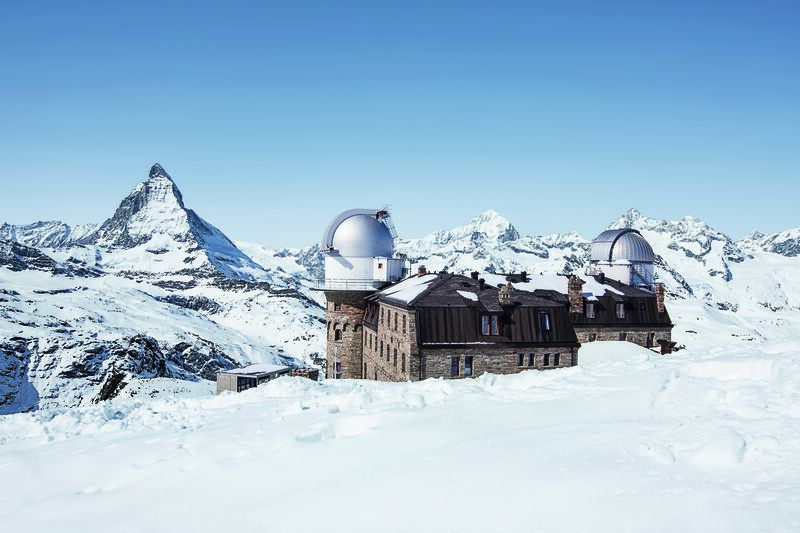
At the train’s arrival, the Kulmhotel 3100 Gornergrat dominates the ridge. Built in 1907 in brown stone and timber architecture, equipped with two astronomical observatory domes (one operated by EPFL/ETHZ, the other public), it is the highest hotel at 3100 metres in the Alps. One sleeps in simple yet panoramic rooms, and takes breakfast on a terrace overlooking the Gorner glacier.
The summit offers an immersive exhibition “ZOOOM the Matterhorn”, opened in 2020: three rooms including a 360-degree projection and a flight experience over the massif. For visitors who ascend only an hour, it is the supplement that justifies the journey’s duration. A few metres further on, alpine ibex sculptures recall the animal’s regular presence on Gornergrat’s ridges, a colony having been observed several times since the 2010s.
What one sees from the ridge
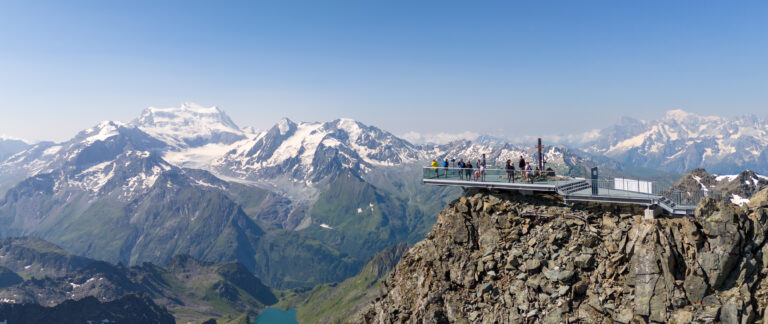
The panorama warrants a map on-site. To the south-west, the Matterhorn, its east face in full height, is the central element of the scene. Further west, Dent Blanche (4357m) and Obergabelhorn (4063m) close the horizon line. To the south-east, the Mont-Rose massif unfolds its Gorner glacier, one of the longest in the Alps after the Aletsch glacier. Above, Dufourspitze rises to 4634 metres, Switzerland’s highest peak.
Twenty-nine summits exceed 4000 metres within the field of view. A graphic orientation panel installed on the terrace names them one by one. In the morning, raking light sculpts the ridges; at midday, the Matterhorn loses some relief beneath the zenith sun. Professional photographers favour the arrival of the first train at 8:00.

Zermatt
Travel Book AEC CollectionPractical matters: the journey
The Gornergrat Bahn station sits directly opposite Zermatt CFF station, on the station square. Trains depart every 24 minutes in high season, every hour in off-season. The upward journey takes 33 minutes, with stops at Riffelalp (2211m), Riffelberg (2582m) and Rotenboden (2815m). Each station opens onto distinct viewpoints, and it is common to descend on foot between two stops (the Riffelberg → Riffelalp path takes one hour).
In winter, the Peak Pass ticket combines train and cable-car access, offering descent routes from Rotenboden or Riffelberg back to Zermatt. In summer, a simple return ticket suffices for the day. Arrival on the first train ensures clear light and a free terrace; the last train descends around 19:00 in summer, earlier in winter, verify the exact timetable according to season.
When to visit
Gornergrat is open year-round. January to March for fresh snow and skiing. June to July for alpine flowers and hiking towards Riffelsee, the glacial lake that reflects the Matterhorn on calm days. September to October for early snow without the crowds, and the orange hues of larch trees near Riffelalp. Avoid: summer thunderstorm days, when the ridge may close at the summit for safety reasons.
Planning a stay in Zermatt
AEC Collection selects and represents some twenty properties in Zermatt: private chalets at Winkelmatten and Riedweg, upmarket apartments in the village centre, suites with hotel services. All are visited by our agents before entering the catalogue.

Our properties in Zermatt
Exceptional chalets, villas and apartments, selected by our agents for their standing.
View the properties in Zermatt →