
Fort de Ronce: the Italian fortification of the Mont Cenis pass
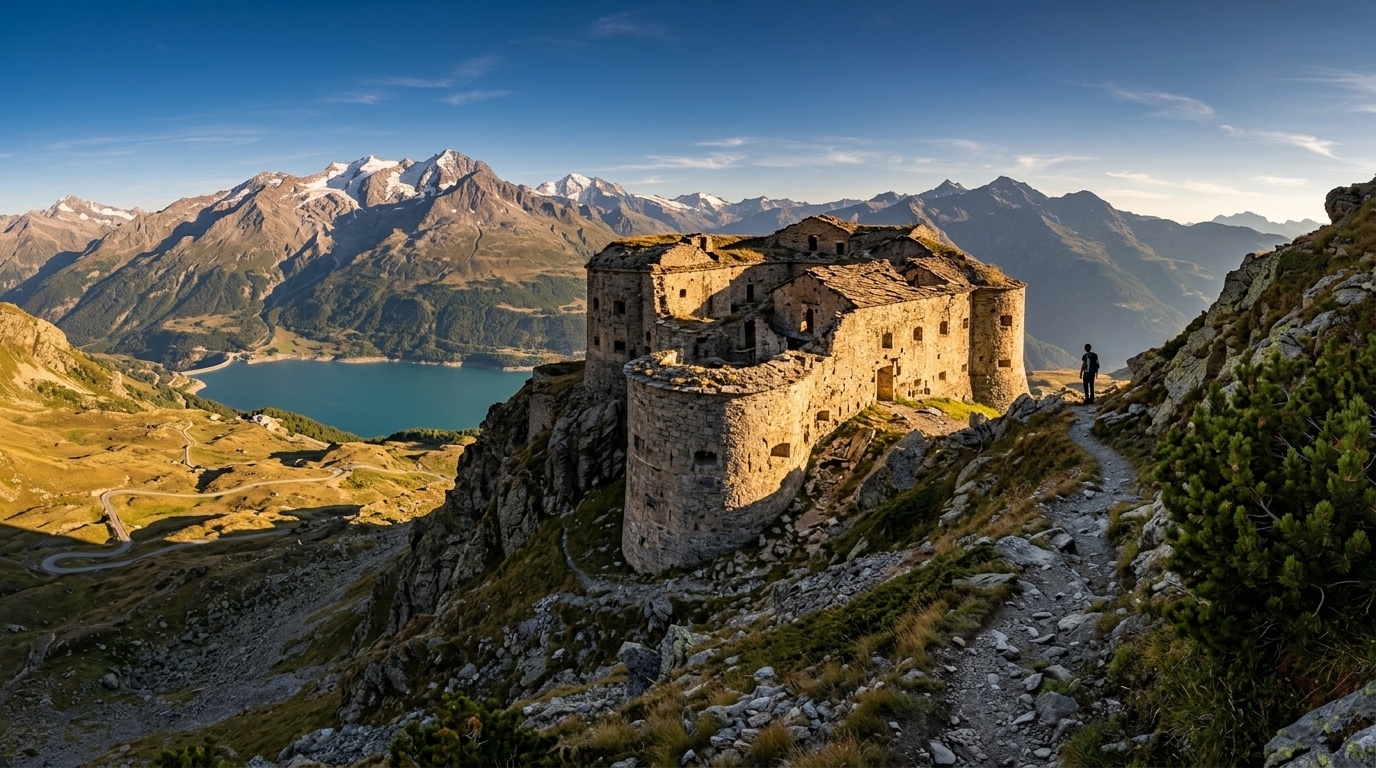
At 2,301 metres altitude, perched on the ridge overlooking the Mont Cenis pass, Fort de Ronce is one of the most impressive mountain fortifications in the Alps. Its distinctive two-storey circular silhouette, built of brown stone, rises above the Mont Cenis lake and the Italian horizon, an unexpected presence in an otherwise barren, mineral landscape.
The fort was not originally French. It was constructed by the Kingdom of Italy between 1877 and 1880, on what was then Italian territory, to defend the new kingdom against a possible French invasion over the pass. The Paris Treaty of 1947 redrawn the border, placing the entire structure on the French side, a geopolitical legacy in stone.
A fortification designed for rifled artillery
The fort’s design follows the principles of the Marquis de Montalembert, an 18th-century military engineer whose theories were still being applied in the late 19th century. The circular form, with two tiers of fire, concentrates defensive firepower over 360 degrees and commands all approaches to the pass. The thickness of the walls, calculated to withstand the rifled artillery of the period, reaches several metres at the most exposed points.
When commissioned, the fort was equipped with six casemented artillery pieces. Its role was clear: to hold the Mont Cenis pass, in coordination with other Italian works (Fort de la Cassa, the Turra batteries) which formed an integrated defensive system.
Disarmed, rearmed, abandoned
The fort’s military history is eventful. At the outbreak of the First World War, Italy withdrew from the Triple Alliance and sided with the Entente: the fort was disarmed, its defensive role becoming redundant with France now an ally. Two decades later, deteriorating Franco-Italian relations in the 1930s led to its rearmament: 100/17 Skoda artillery pieces were installed, and concrete bunkers and gun turrets were added to modernise the position.
The Second World War saw the fort involved in several skirmishes in June 1940 during the Italian offensive against France. After the war, the Paris Treaty of 1947 returned the Mont Cenis sector to France. The fort, its military purpose now obsolete, was progressively abandoned. Today it remains in a state of stabilised ruin, accessible to hikers.
Access by hiking
Access to the fort is on foot only, from the Mont Cenis pass. The marked path starts from the dam car park and climbs in a loop of approximately 3 hours round trip, with an elevation gain of 400 metres. The walk is graded moderate, with no technical passages, though sun exposure on open sections and a risk of afternoon thunderstorms in summer should be considered.
Arrival at the fort is among the highlights of the walk. The sweeping views over the Mont Cenis lake, a water catchment created by the Italian dam in the 1960s, and the Ambin massif on the Italian side, justify the climb. The fort’s interior can be explored freely; there are no interpretive panels or attendant.
When to visit
The Mont Cenis pass is closed in winter. Access to the fort is possible from June to October, depending on residual snow conditions. The best window is July-August for weather safety and full road access, or September for golden larch trees on the plateau.
Planning a stay at Val Cenis
AEC Collection selects and represents chalets and apartments at Val Cenis and in the Maurienne valley. The walk to Fort de Ronce and other military works at Mont Cenis can be undertaken independently or with a qualified mountain guide.
Our properties in Val Cenis
Exceptional chalets, villas and apartments, selected by our agents for their standing.
View the properties in Val Cenis →