
Alpine Botanic Garden La Jaÿsinia: 8000 plants from around the world above Samoëns
Above the centre of Samoëns, clinging to a south-west-facing limestone slope, rises the Alpine Botanic Garden La Jaÿsinia, a garden designated a ‘Remarkable Garden’, created in 1906 and placed under the scientific direction of the National Natural History Museum from 1936 to 2023. Behind the project’s foundation lay a notable figure: Marie-Louise Cognacq-Jaÿ, daughter of Samoëns farmers who became co-founder of La Samaritaine in Paris.
The garden today houses 8000 plants, comprising 4500 species and varieties, the vast majority from five continents: mountain flora and cold-region vegetation from around the world, from the Caucasus to the Andes via the Himalayas and Rockies.
From Samoëns to La Samaritaine, and back
Marie-Louise Jaÿ, born in Samoëns on 1 July 1838 to a modest family, left the village aged 15 to try her luck in Paris. There she met Ernest Cognacq, whom she would marry, and together they founded the department store La Samaritaine, which became, within several decades, one of the largest commercial houses in Europe.
The couple, childless, undertook considerable philanthropic work. From 1904, Marie-Louise conceived the idea of offering her native village an alpine botanic garden and a villa intended to house a doctor, a project as much social as cultural, in a Samoëns that was still isolated. The work was entrusted to Jules Allemand, landscape architect known for the rockeries of Ariana Park in Geneva.
200 workers, two years of construction
The chosen site was a steep slope, dotted with limestone blocks, overlooking the village. 200 workers were mobilised for two years (1905-1906) to excavate terraces, build retaining walls, transport topsoil, and plant the first specimens. An artificial waterfall, ponds, a kiosk and a neo-Gothic chapel completed the layout. The opening took place in September 1906.
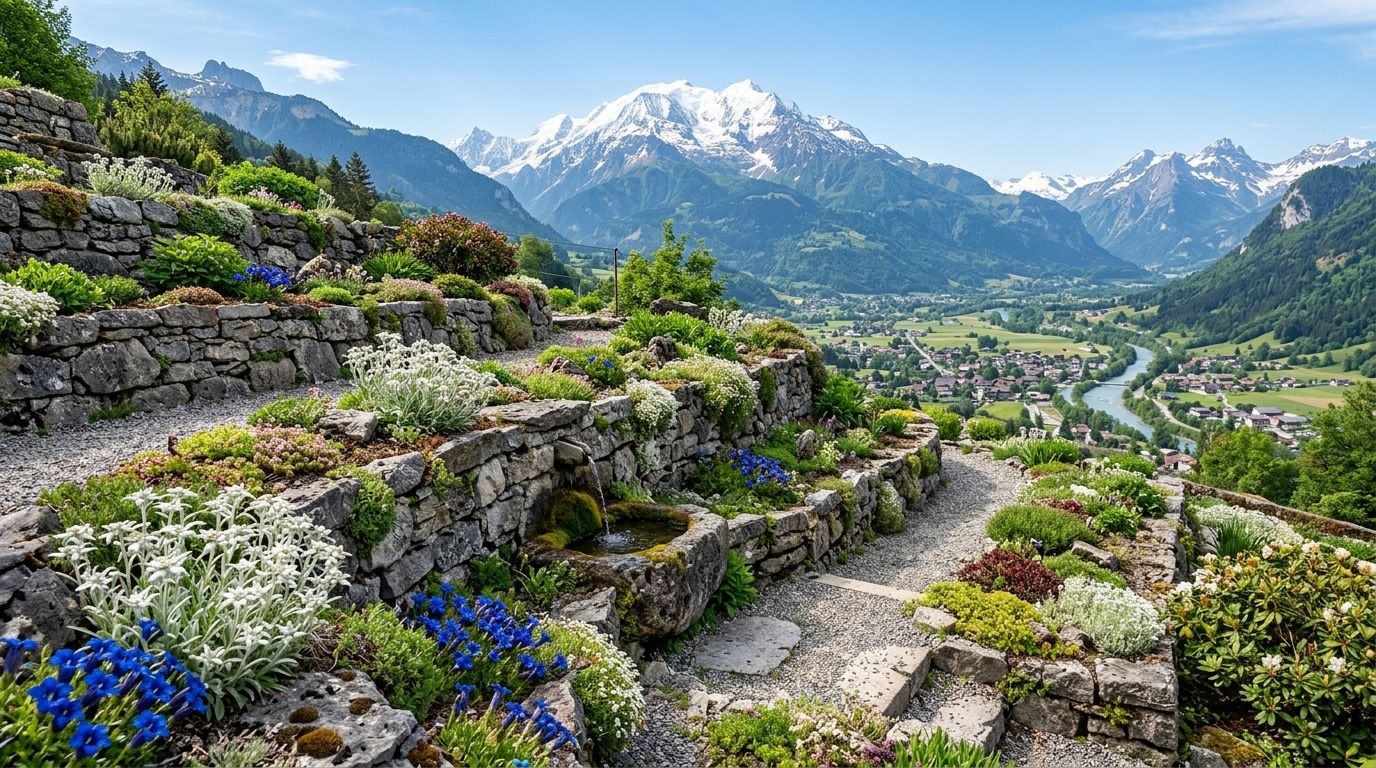
The original landscape architecture remains highly legible today: winding paths, viewpoints over the Giffre valley, rockeries evocative of high alpine terrain reconstructed at 720m altitude.
Five continents in a single garden
The collection is organised by biogeographic zones: Alps, Pyrenees, Massif Central, Caucasus, Himalayas, Siberia, North America, Andes, New Zealand. This anchoring in cold altitudes across the world allows the cohabitation, over several hectares, of plants that never meet in nature, alpine gentians neighbouring Himalayan saxifrages, edelweiss beside Caucasian rhododendrons.
The Museum’s scientific direction long made La Jaÿsinia a repository for rare or threatened plants. Several species safeguarded there have been reintroduced in situ in their natural habitat.

Samoëns
Travel Book AEC CollectionWhen to visit
The main flowering period runs from May to July, when the garden displays its fullest palette. September remains worthwhile for late-season flowering and autumn colours. Entry is free. Allow 1.5 to 2 hours for an unhurried visit; the internal elevation gain is noticeable (the chapel is at the highest point, at 850m), so wear sturdy shoes.
Planning a stay in Samoëns
AEC Collection selects and represents quality chalets and apartments in Samoëns and neighbouring villages of the Haut-Giffre. The garden can be visited independently from the village centre.

Our properties in Samoëns
Exceptional chalets, villas and apartments, selected by our agents for their standing.
View the properties in Samoëns →