
Aiguilles de Bavella: seven granite peaks in the heart of Corsica
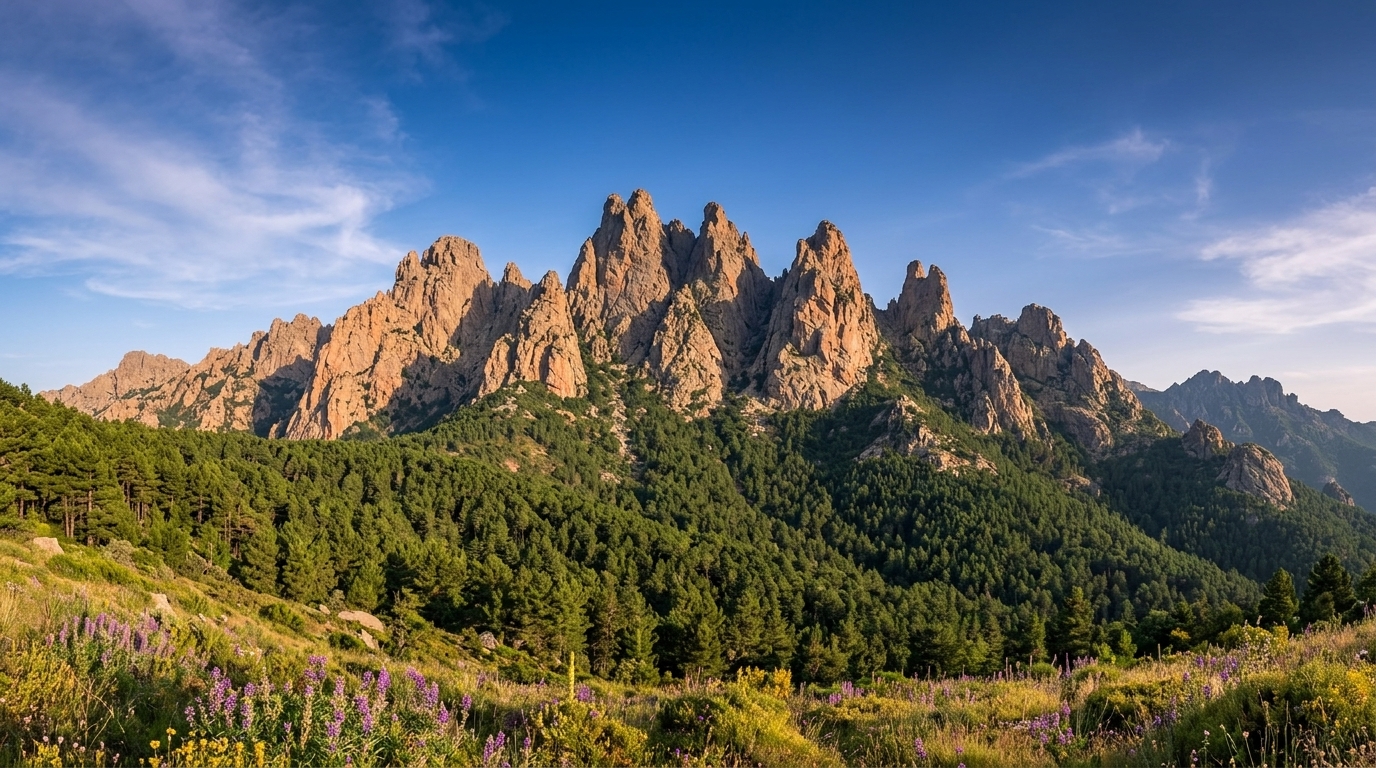
The Bavella Pass sits at 1,218 metres altitude. Reached from Solenzara via a one-hour winding drive up the Travu valley, passing through several upland hamlets, Sari-Solenzara, Sainte-Lucie, Quenza, before emerging on to the approach plateau. At this point, the landscape changes abruptly. Seven grey-pink granite needles rise to the right of the pass, some slender as fingers, others squat like pillars.
These are the Aiguilles de Bavella, one of the most striking rock formations in inner Corsica and an essential passage on the GR20.
Seven needles, several summits
The Aiguilles de Bavella form an alignment of seven steep granite peaks, the highest reaching 1,855 metres. Further north, the massif culminates at Punta di u Furnellu and Punta Muvrareccia (1,899m each). The landscape is austere and mineral: no glaciers, no permanent snow, the needles rising above forests of Corsican black pine, a species endemic to the island with silhouettes twisted by the wind.
The view from the pass is immediate and unobstructed. To the right, the needles. To the left, the valley and the first foothills descending towards the coast. It is one of the few roadside vantage points from which, in clear conditions, one can see both the sea to the east and the snow-capped summits of Monte Cinto to the north-west.
The Trou de la Bombe trail
The signature route from the pass is the trail leading to the Trou de la Bombe, a unique geological formation within the massif. It is a circular opening of eight metres diameter, naturally pierced by wind and rain erosion through the Paliri ridge. The name “bombe” is misleading: no shell excavated this hole, only wind and time, over millennia.
The route is marked in red. From the pass (1,218m), the round trip takes approximately 4 hours, with a positive gradient of 250 metres. The trail crosses the Corsican black pine forest, skirts a few rocky slabs, and emerges directly on to the Paliri ridge where the hole opens. The view through the opening on to the Tavignano valley is one of the classics among Corsican hiking accounts.
The GR20 at the foot of the needles
The GR20, the long-distance hiking trail crossing Corsica from north to south (or vice versa), passes at the foot of the Aiguilles de Bavella during its penultimate stage, stage 15, between Asinau and Paliri refuges. It is one of the most mineral and most photogenic sections of the trail.
For non-GR20 hikers, the trail can be undertaken intermittently from the pass: descending to Paliri refuge (allow 5 to 6 hours round trip) or ascending to Asinau (8 to 10 hours, best avoided without experience). The stretches at the foot of the needles are among the most picturesque of the entire Corsican route.
Climbing and alpinism
The Aiguilles de Bavella are one of the premier destinations for granite climbing in Corsica. Several multi-pitch routes open on to the more accessible peaks; classic lines are done with a qualified guide. The amateur climber finds suitable terrain on the boulders and short routes near the pass.
When to visit
The pass is accessible from May to October for hiking; the road remains open year-round, though winters are cold and snow is possible. The ideal window is June and September: manageable warmth, fewer visitors, contrasting light on the granite. Summer thunderstorms are frequent in late afternoon; aim for an early arrival and descend before 5pm.
Planning a stay in Solenzara
AEC Collection selects and represents villas and apartments in Solenzara and on the eastern coast. Hiking to Bavella, like other interior routes, can be undertaken independently or with a qualified guide.
Our properties in Solenzara
Exceptional chalets, villas and apartments, selected by our agents for their standing.
View the properties in Solenzara →