
Filitosa: 8,000 years of history and the statue-menhirs carved around 1200 BC
The prehistoric site of Filitosa, at Sollacaro in the Taravo valley, is one of the great archaeological sites of the western Mediterranean, and one of the most remarkable. Across a few hectares of maquis, statue-menhirs with carved faces, some standing more than two metres tall, punctuate a route that spans nearly 8,000 years of human occupation. A visit to Filitosa is not a cultural outing; it is a confrontation with an unresolved archaeological mystery.
1946: the farmer’s discovery
The site was discovered in 1946, under very ordinary circumstances: Charles-Antoine Cesari, the landowner, was turning over his plot to cultivate it and uncovered worked stones that did not appear natural to him. He alerted the authorities. The archaeologist Roger Grosjean was tasked with the site a few years later, and systematic excavation began in the 1950s.
What Grosjean unearthed transformed the understanding of Corsican prehistory: not only had the site been occupied since the VIth millennium BC (Early Neolithic), but it yielded statue-menhirs with carved human faces unique in their kind.
The statue-menhirs: a people represented
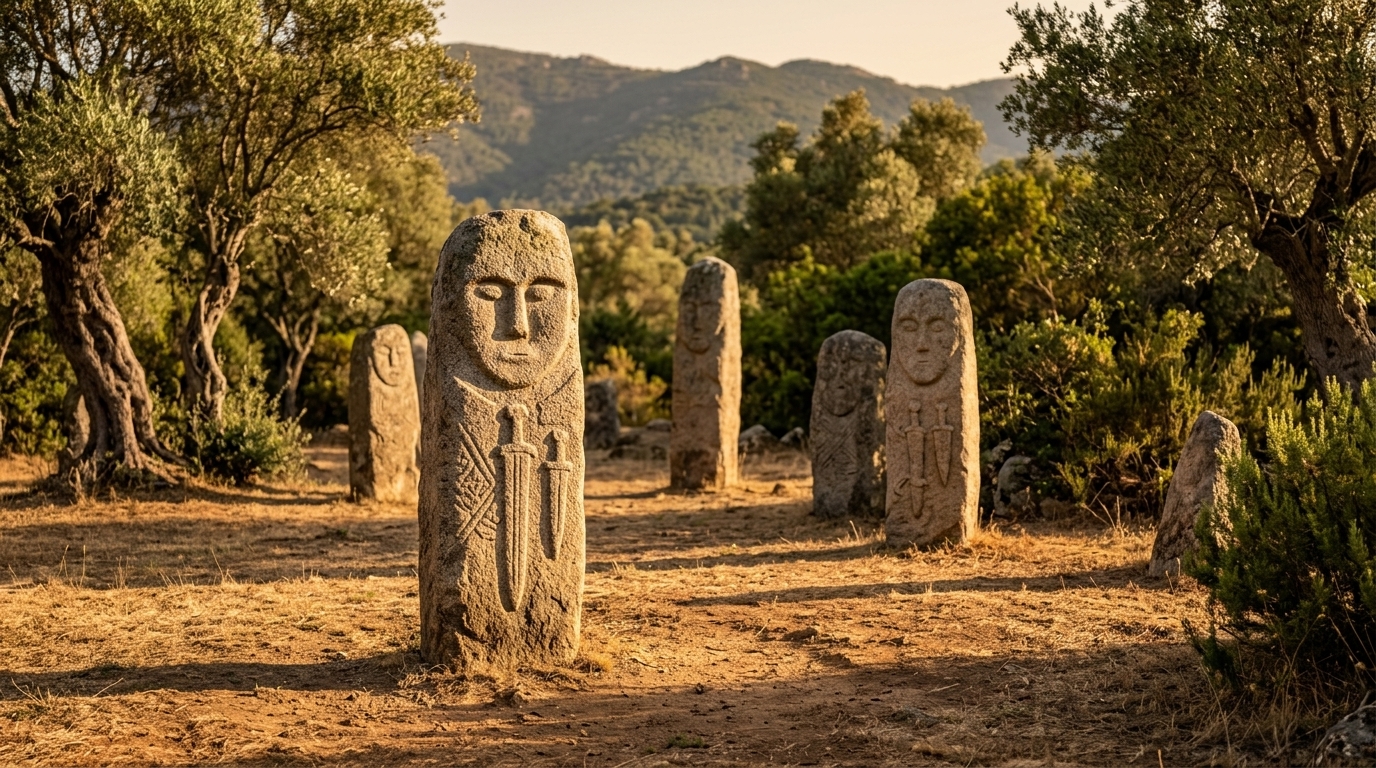
The site contains thirteen statue-menhirs of the Corsican group, erected in the IVth millennium BC but carved around 1200 BC, thus reworked several millennia after their initial installation. They all display human features: frontal face, sometimes schematic eyes and nose, some bearing a baldric or a sword carved on the shoulder.
Several hypotheses coexist: portraits of deified ancestors, representations of conquered warriors, funerary idols. No interpretation commands consensus among archaeologists. What remains certain is that the statues are not anonymous; each bears its own face, treated with remarkable technical care for the period.
The Torréans: a warrior people around 1600 BC
Around 1600 BC, in the Bronze Age, a new population settled on the site. Archaeologists, lacking a historical name, baptised them the Torréans, after the torre (circular towers of dry stone) they built. The remains of three Torréan monuments are still visible on the site.
A macabre peculiarity, and a precious one for archaeology: the Torréans toppled and shattered the statue-menhirs they found on site, then reused them as building material in the walls of their towers. Paradoxically, this is what allowed the statues to traverse the millennia, buried within the masonry, protected from erosion, until their exhumation by Grosjean.

Propriano
Travel Book AEC CollectionThe visitor route
The site can be visited in 1 to 1.5 hours, along a marked path that crosses the oppidum, circles the torre and tours the principal statues. A small museum at the entrance displays Neolithic tools, ceramics and the most fragile pieces. The ancient olive tree (estimated at between 1,000 and 1,200 years old) that stands near the site is, in itself, another living monument.
The ground is in full sun over most of the route; a hat and water are essential in summer. The late afternoon offers the best light for observing the carvings, whose details are revealed in low-angle light.
When to visit
The site is open from April to end October. May, June and September, October are the best windows: maquis still green (or coloured anew in autumn), manageable temperatures, moderate visitor numbers. July, August remains feasible, but prefer the first hour of opening or the last of the day to avoid the heat.
Planning a stay in Propriano
AEC Collection selects and represents villas and period properties in Propriano, Olmeto, Sollacaro and around the Golfe du Valinco. Tickets can be reserved online or on site.

Our properties in Propriano
Exceptional chalets, villas and apartments, selected by our agents for their standing.
View the properties in Propriano →