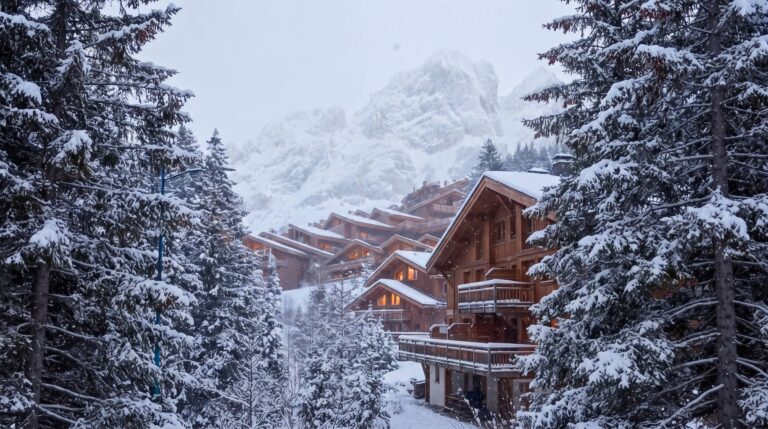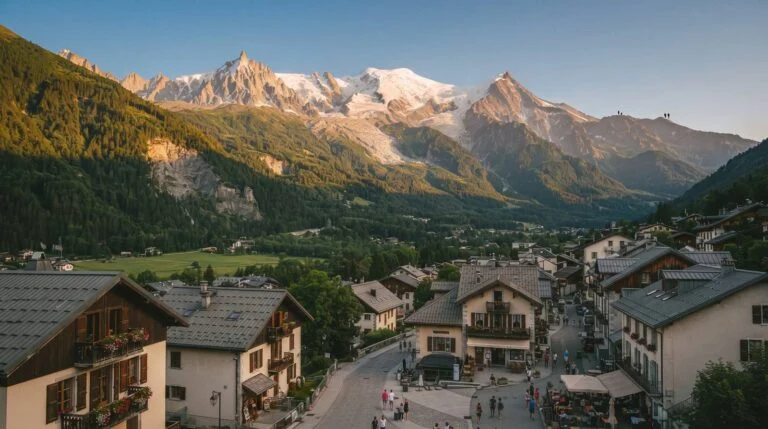

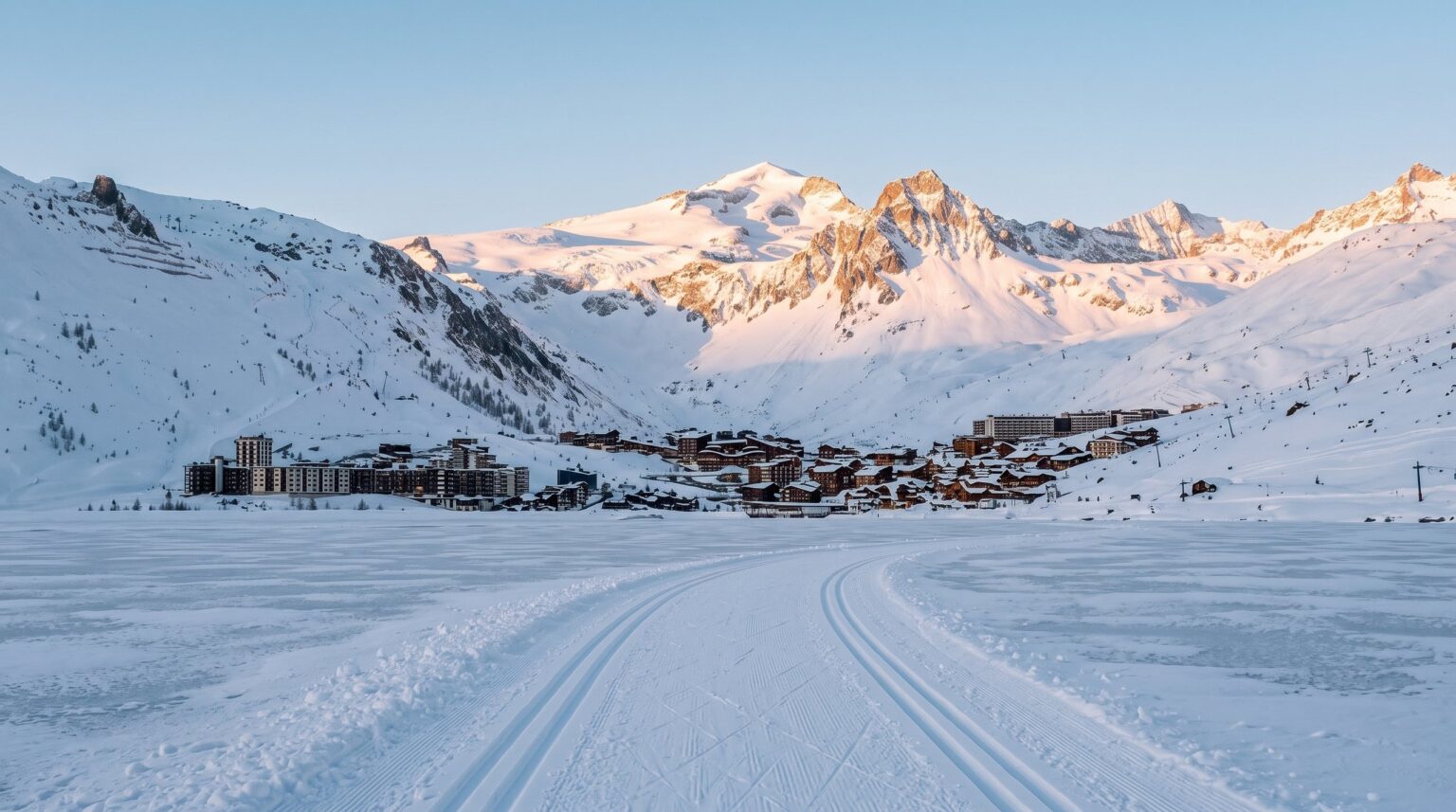
They share the same ski area, the same lift pass and the same valley in the upper Tarentaise. Yet Val d’Isère and Tignes have little in common. One is an old mountain village strung out along the Isère; the other is a resort rebuilt higher up, around a lake, after the Chevril dam flooded the original village in 1952. Choosing between them means choosing your base camp on the same playground. Here is how they differ, point by point.
Val d’Isère and Tignes at a glance
- Ski area: Tignes-Val d’Isère, around 300km of pistes according to both tourist offices, from 1550m to 3456m.
- Val d’Isère: village at 1850m, season from 28 November 2026 to 2 May 2027.
- Tignes: villages from 1550m to 2150m, season from 21 November 2026 to 2 May 2027, linked with Val d’Isère from 28 November.
- Getting there: Bourg-Saint-Maurice station, then around 40 minutes by bus to Val d’Isère and an hour to Tignes, according to official sources.
Two histories, one ski area
Val d’Isère has kept its old village. Its tourist office speaks of the “historic heart of Val d’Isère”, a village “on a human scale” that is “best explored on foot”, gathered around the church of Saint-Bernard-de-Menthon and its bell tower of 1664. The resort stretches from La Daille to Le Fornet, and a free shuttle bus, “le train rouge” (the red train), runs from one end to the other.
Tignes has a different story to tell. In 1952, when the sluice gates of the Chevril dam were closed, the original village was drowned; eighty-seven families were evacuated, and the church was rebuilt exactly as it had been, higher up, at Les Boisses. The resort settled at 2100m, around a natural lake of more than twenty hectares that freezes so hard in winter you can walk across it. Its tourist office sums it up in four words: “Diverse, sporty, irreverent, committed”.
The villages: one centre or five districts
In Val d’Isère, everything revolves around the centre and its snowfront, with La Daille at the entrance to the resort and the hamlets of Le Laisinant and Le Fornet at the head of the valley. Our guide to the districts of Val d’Isère compares them one by one. A free shuttle bus links the two resorts: see our guide to the Val d’Isère shuttle bus.
In Tignes, the tourist office describes five villages. Lower down, Les Brévières, at 1550m, offers a “return to the authentic”, while Tignes 1800, at Les Boisses, sets out to be “designed especially for families”. Higher up come the three villages of Tignes 2100: Le Lavachet, at 2050m, for “a little peace and quiet”; Le Lac, at 2100m, the “centre of the resort”; and Val Claret, at 2150m, “festive and sporty”, where, according to the tourist office, you go “from the ski runs to the dance floor”.
The skiing: same snow, two ways in
The ski area is shared, and so is the lift pass: around 300km of pistes according to both tourist offices, from 1550m at Les Brévières up to 3456m on the Grande Motte. In Tignes, the Perce-Neige funicular climbs to 3032m, then a cable car takes over to 3456m, onto a glacier the tourist office says is skiable from November to May. Tignes also bills itself as a “land of freestyle”: it hosted freestyle skiing at the 1992 Games, then the Winter X Games Europe from 2010 to 2013.
In Val d’Isère, the benchmark is still the Face de Bellevarde, a black run of around 3km with 850m of vertical drop. It hosted four men’s events at the 1992 Games and, together with the Oreiller-Killy piste, stages the Critérium de la Première Neige; this winter only the men’s races are on the programme, with the giant slalom on 12 December and the slalom on 13 December.
AEC tip. Since the ski area is shared, choose your resort for what you will do off the slopes: the old village and its lanes in Val d’Isère, or the lake, the high-altitude villages and the sporty atmosphere of Tignes.
The season, and summer
Tignes opens first, on 21 November 2026, and the link with Val d’Isère follows on 28 November, the day Val d’Isère opens; both close on 2 May 2027. In summer, both glaciers reopen for a few weeks of skiing: the Grande Motte in Tignes, from 20 June last summer, and the Pissaillas in Val d’Isère, from 6 to 21 June.
For families, and for peace and quiet
Both resorts hold the Famille Plus family-friendly label, and the Tignes-Val d’Isère lift pass is free for children under 8 this season. In Tignes, the Lagon aquatic centre, in Le Lac, has a 25m pool, a wellness area and a gym; the pool is free with a lift pass of six days or more. In Val d’Isère, the aquatic and sports centre sits at the foot of the Face de Bellevarde. Our guide to family ski holidays covers childcare and lessons in detail.
Val d’Isère or Tignes: side by side
| Criterion | Val d’Isère | Tignes |
|---|---|---|
| Character | Old village, “on a human scale” | “Diverse, sporty, irreverent, committed” |
| Altitude | 1850m, 1930m at Le Fornet | From 1550m at Les Brévières to 2150m at Val Claret |
| Season 2026-2027 | 28 November to 2 May | 21 November to 2 May |
| Glacier | Pissaillas | Grande Motte, up to 3456m |
| Shuttle buses | Free, “le train rouge” | Free, all day |
| From Bourg-Saint-Maurice | About 40 minutes by bus | About an hour by coach |
| Big event | Critérium de la Première Neige | Freestyle heritage, Winter X Games 2010 to 2013 |
Where to stay
You will find our chalets and apartments under our rentals in Val d’Isère and our rentals in Tignes. To step into your skis at the chalet door, see our ski-in ski-out chalets in Val d’Isère, and if you are still weighing them up against Les 3 Vallées, our comparison Courchevel or Val d’Isère sets out the facts. For the start of the season, see our guide to ski resort opening dates; for the end, our guide to Easter ski holidays. For Val d’Isère, our guide what to do in Val d’Isère in winter brings together days on skis and off them.
The simplest way is to write to us: tell us your dates and the size of your party, and our agents will put together a selection in one resort, the other, or both.
All that remains is to choose between the lanes of the old village and the frozen lake of Tignes, beneath the same peaks.
Frequently asked questions
What is the difference between Val d’Isère and Tignes?
Val d’Isère is an old mountain village at 1850m, strung out along the Isère. Tignes was rebuilt higher up, around a lake, after the Chevril dam flooded the original village in 1952; its villages range from 1550m at Les Brévières to 2150m at Val Claret.
Do Val d’Isère and Tignes share the same ski area?
Yes. The Tignes-Val d’Isère ski area has around 300km of pistes according to both tourist offices, from 1550m to 3456m on the Grande Motte, with a shared lift pass.
Which opens first this winter, Tignes or Val d’Isère?
Tignes, on 21 November 2026. Val d’Isère opens on 28 November, the same day the link between the two resorts opens; both close on 2 May 2027.
Where should I stay in Tignes?
In Le Lac, the centre of the resort; in Le Lavachet for more peace and quiet; in Val Claret for a festive, sporty atmosphere; in Tignes 1800, designed for families; or in Les Brévières, at 1550m, for a return to the authentic.
Is Val d’Isère or Tignes better for families?
Both hold the Famille Plus label, and the Tignes-Val d’Isère lift pass is free for children under 8 this season. Tignes also has the Lagon aquatic centre, in Le Lac.
Can you ski in summer in Tignes and Val d’Isère?
Yes, for a few weeks: in 2026, the Grande Motte glacier in Tignes reopened from 20 June, and the Pissaillas glacier in Val d’Isère from 6 to 21 June.
How do you get to Val d’Isère and Tignes?
By train to Bourg-Saint-Maurice station, then around 40 minutes by bus to Val d’Isère and an hour by coach to Tignes.