
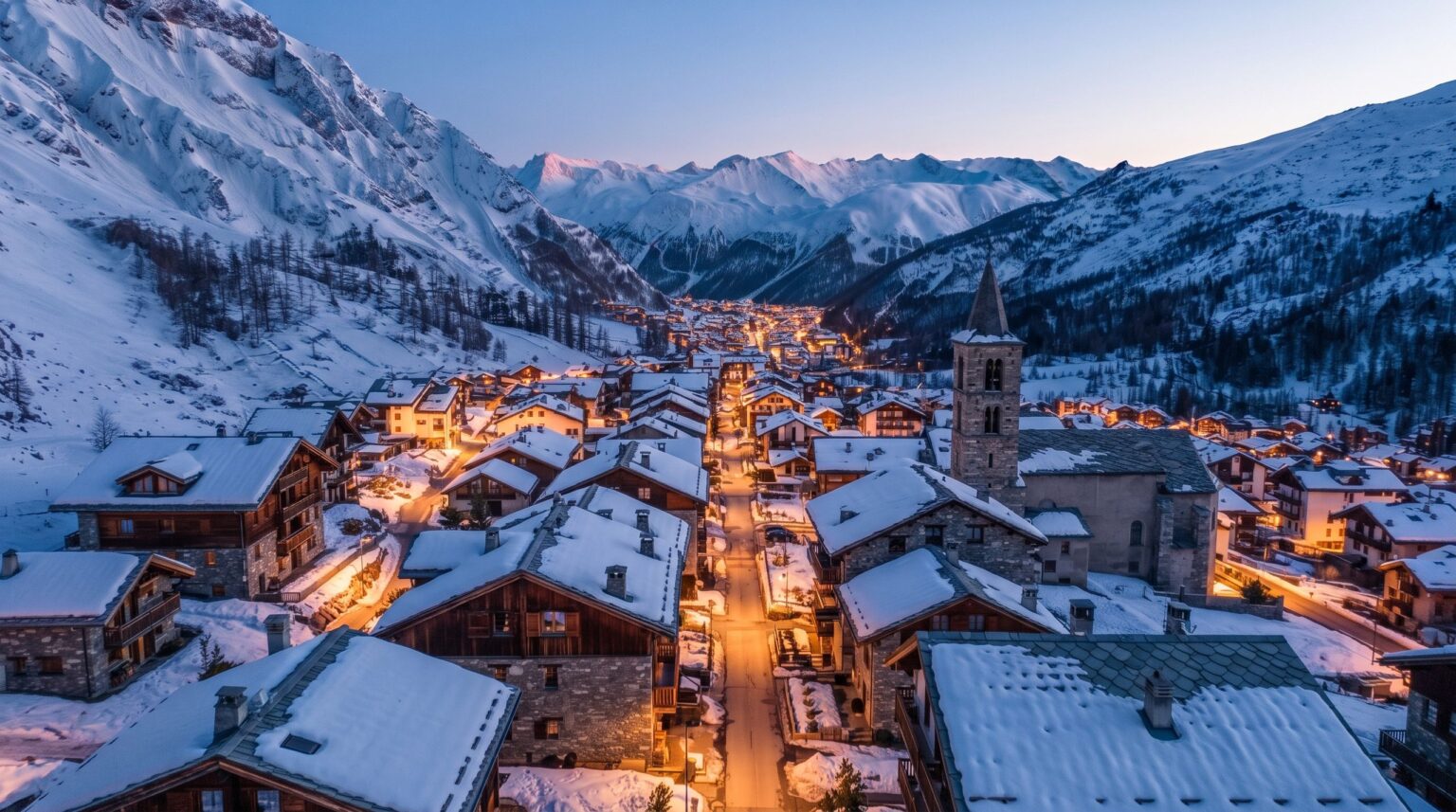
There is more to Val d’Isère than its centre. At 1850m, the village stretches along the Isère, from La Daille, at the entrance to the resort, to Le Fornet, at the end of the road, where the way over the Iseran closes for the winter. In between lie hamlets, chapels and a single ski area, shared with Tignes. Free shuttle buses link the whole lot, and the main line, “the red train”, runs from La Daille to Le Fornet. So the area you pick does not change the skiing on offer, only the first quarter of an hour of each day: clicking into your skis outside the chalet, taking the Funival or heading up towards the glacier.
Val d’Isère in practice
- Altitude: the village at 1850m, the hamlet of Le Fornet at 1930m.
- Ski area: Tignes-Val d’Isère, formerly the Espace Killy.
- 2026-2027 season: 28 November 2026 to 2 May 2027.
- Shuttle buses: free Val bus services, including the Red line from La Daille to Le Fornet, roughly every 10 minutes according to the tourist office.
- Getting there: Bourg-Saint-Maurice station is about 40 minutes away by bus.
A village strung out along the Isère
Finding your way around is simply a matter of following the valley. At the entrance to the resort, La Daille greets those arriving by road and at the bus station. In the middle, the centre brings together the old village, the snow front and the Rond-Point des pistes. To the east, the road runs on to Le Laisinant and then Le Fornet. Lastly, the Manchet valley and the hamlet of Le Joseray are a world apart, quieter, somewhere between cross-country skiing and a baroque chapel. To find out which line serves each area, see our guide to the Val d’Isère shuttle bus.
The free Val bus shuttles stitch it all together. According to the tourist office, the Red line links La Daille and Le Fornet roughly every 10 minutes, the Blue serves the Rond-Point des pistes and La Legettaz every 15 minutes, the Yellow serves Le Coin and Le Manchet every 20 minutes, and the Violet heads off to Tignes 1800. Detailed winter timetables are on the Val d’Isère tourist office website.
The centre: the old village and the snow front
The tourist office calls it “the historic heart of Val d’Isère”. Its narrow streets huddle around the church of Saint-Bernard-de-Menthon, a listed historic monument whose belfry dates from 1664, and “the village, built on a human scale, is explored on foot”. This is also where the skiing comes home: Solaise and the Olympique bring you back to the snow front, in the heart of the village.
The Face de Bellevarde, a black run of about 3km with an 850m vertical drop, hosted four men’s events at the Albertville Olympics in 1992. Together with the Oreiller-Killy piste, it hosts the Critérium de la Première Neige, which began in 1955; this winter only the men’s races are on the programme, with the giant slalom on 12 December and the slalom on 13 December 2026. For first turns, the Savonnette drag lift and the Village chairlift, on the snow front, are free, and the ESF snow garden is there for the youngest.
Who is it for? Anyone who wants to do everything on foot, from the morning ski lesson to dinner in the evening, and families who are just starting out.
La Daille: at the foot of the Funival
At the entrance to the resort, La Daille was built in the 1970s around an old village, marked out by its chapel of Saint-Germain, built in 1939. Its great asset comes down to one word: the Funival, the funicular that climbs to Bellevarde. The Daille gondola offers a second way up, the Lanches drag lift is free for beginners, and this is also home to the Oreiller-Killy piste. Confident skiers know the Village Perdu play area, too, in the Daille forest.
The bus station is now here, and the red train reaches the centre in under 10 minutes. The ESF has an office here and a children’s area on the snow front.
Who is it for? Skiers who want to be first to the top of Bellevarde, and anyone arriving by bus.
AEC tip. In Val d’Isère, look at the shuttle line as closely as the address: a chalet a few steps from a Red line stop is often a better bet than a more central one that is a long way from any stop.
Le Laisinant and Le Fornet: peace at the end of the valley
Heading east, Le Laisinant is the last hamlet before Le Fornet, with its chairlift and its chapel of Saint-Barthélemy, on the Red line.
At the end of the road, Le Fornet is a “hamlet perched at an altitude of 1930m” which, according to the tourist office, “has kept all its authenticity”. Around 70 people live here all year round, and many of the chalets are let in winter. The Fornet cable car, built in 1972, rises towards the Iseran and the Pissaillas glacier, and the Vallon gondola, opened in December 2024, climbs to the foot of the glacier at 2790m. The tourist office points to “a wide choice of green and blue runs”. This is where the Red line ends, and the Iseran road stays closed all winter.
Who is it for? Anyone after the calm of a real hamlet, and skiers who like to start the day on the glacier runs.
Le Joseray and Le Manchet: another Val d’Isère
The chapel at Le Joseray looks down over the Manchet valley; the town hall sees it as “the most intimate example” of the local baroque. It was at Le Joseray that the central training school opened in 1937-1938, awarding its first ski instructor diplomas here. The Manchet valley, for its part, is one for cross-country skis: twelve kilometres of free loops running to the centre, with a restaurant, ruins and a waterfall at the head of the valley. The Yellow line serves both.
Val d’Isère’s areas at a glance
| Area | Location | Feel | Nearby lifts | Shuttle bus |
|---|---|---|---|---|
| Centre | Heart of the village, 1850m | Old village, snow front | Solaise, Olympique | Red and Blue |
| La Daille | Entrance to the resort | 1970s apartment blocks, bus station | Funival, Daille gondola | Red |
| Le Laisinant | Road to Le Fornet | Hamlet, chapel | Laisinant chairlift | Red |
| Le Fornet | End of the valley, 1930m | Authentic hamlet, quiet | Fornet cable car, Vallon gondola | Red, last stop |
| Le Joseray, Le Manchet | Manchet valley | Baroque chapel, Nordic valley | Cross-country skiing | Yellow |
Where to unpack
All our chalets and apartments in the resort are gathered in our Val d’Isère rentals. To click into your skis at the chalet door, our selection of ski-in ski-out chalets in Val d’Isère gets straight to the point. For families, our guide to family ski holidays points out that the resort holds the Famille Plus label and that lift passes are free for children under 8; before you book, our guide to renting a luxury chalet answers the practical questions. To reach the village, see our guide on how to get to Val d’Isère. To fill the week, skiing or not, see our guide to what to do in Val d’Isère in winter.
The simplest thing is to write to us: give us your dates and the number of guests, and our agents will put together a selection, area by area.
And in the evening, from La Daille to Le Fornet, there will be the red train running alongside the Isère, its windows lit up in the dark.
Frequently asked questions
What is the best area to stay in Val d’Isère?
The centre if you want to do everything on foot, from the snow front to the narrow streets of the old village; La Daille to go up to Bellevarde on the Funival; Le Fornet for the calm of a hamlet at 1930m, where the cable car leaves for the Iseran and the Pissaillas glacier.
La Daille or Val d’Isère centre: which is better?
La Daille, at the entrance to the resort, has the Funival, the Daille gondola and the bus station, and the red train gets you to the centre in under 10 minutes. The centre brings together the old village, the snow front, Solaise and the Olympique.
How do you get around Val d’Isère without a car?
The Val bus shuttles are free. According to the tourist office, the Red line links La Daille and Le Fornet roughly every 10 minutes, the Blue serves the Rond-Point des pistes and La Legettaz, the Yellow serves Le Coin and Le Manchet, and the Violet goes to Tignes 1800.
When does Val d’Isère open this winter?
From 28 November 2026 to 2 May 2027. The men’s Critérium de la Première Neige is scheduled for 12 and 13 December 2026.
Is Val d’Isère good for families?
Yes. The resort holds the Famille Plus label, lift passes are free for children under 8, and the Savonnette drag lift, the Village chairlift and the Lanches drag lift are free for beginners.
Where is Le Fornet in Val d’Isère?
At the end of the valley, at 1930m. The Fornet cable car rises towards the Iseran and the Pissaillas glacier, and the Vallon gondola, opened in December 2024, climbs to 2790m. The Iseran road stays closed beyond the hamlet in winter.
How do you get to Val d’Isère?
By train to Bourg-Saint-Maurice station, then by bus, in about 40 minutes according to the tourist office. The resort’s bus station is in La Daille.